
This post is Names 2, because there is a previous post on the names of the spirits in Frozen II. You can check that out by clicking on this, but it’s not a great post.
Dedicated to topo days, the group that presented on Bikini Bottom names, and Prof. F. P. C.
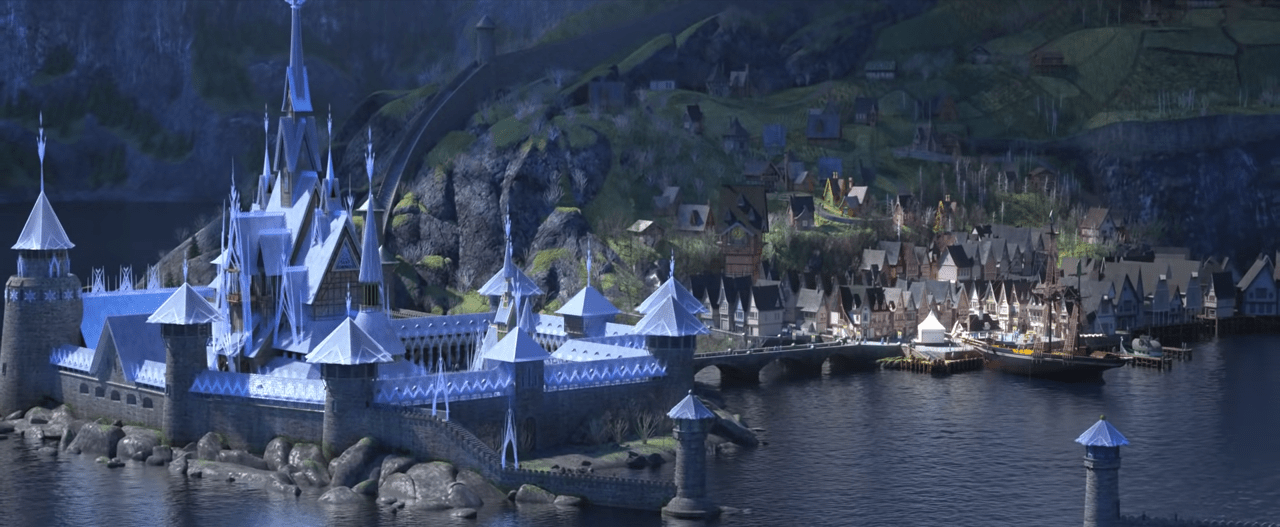
Arendelle! But, what does it mean? And why does some random person on the internet insist on calling it Arnadalr, if not the Queendom of the Crocus?
This post will just be analyses of some of the names of major places (and peoples) in the Frozen canon. So let’s dive into it.
Names in the South
1. Arendelle & Arenfjord
You may know from reading my previous posts that Arendelle is also officially known as Arnadalr – it is called such in the title of a song in the official soundtrack. This word is analysable as arna and dalr, both from Old Norse.
Arna ‘of eagles’ + dalr ‘dale, valley’ = Arnadalr ‘dale of eagles’.
As mentioned in another old post, the name Arnadalr is possibly inspired by the real Norwegian city of Arendal. Wikipedia says that Arendal comes from Arnardalr (with another r in the middle of the word), which means ‘dale of (one) eagle’.
Interestingly, there is a place in England called Arundel. Wikipedia says this place name comes from Harhunedell (as recorded in old sources), where harhune refers to the horehound plant. However, Wikipedia also says that locals believe the name comes from Old French arondelle ‘little swallow’ – a word which is very similar to Arendelle in form!
Well, in the end, I suspect Arendelle was based more on Arendal than Arundel, since Arendal is in Norway.
And now you also know what Arenfjord means!
Aren ‘of eagle(s)’ + fjord = Arenfjord ‘fjord of eagle(s)’
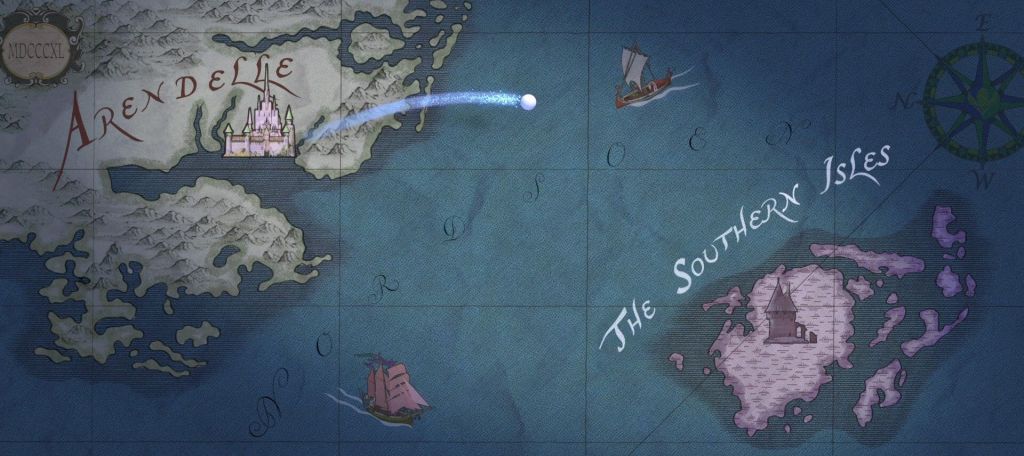
2. The Southern Isles
I really don’t think I need to explain what this name means…
But you might want to know that Denmark, which is south of Norway, contains many islands. In fact, Denmark’s capital, København (Copenhagen) is on the island of Sjælland (Zealand).
I have simply assumed that the Southern Isles IS Denmark in the Saga o.t. Crocus. There is a section in Bk. I Ch. 4 where the Duke of Weselhaven negotiates with Hans, and specifically brings up the conflict between Germany and Denmark over Denmark’s southern duchies.
3. Weselton
We don’t actually know where Weselton is, so let’s do some linguistic decoding to find where Weselton might be located.
The answer is simple: England! Place names ending in -ton are a characteristic feature of English place names within the Germanic languages. It comes from Old English tūn, which means ‘town’, but in most other Germanic languages tūn has changed over time to mean ‘fence’ or ‘enclosure’.
So Weselton mean ‘Wesel Town’. But what is Wesel?
Since we think this place could be in England, we could look for an English or archaic English word which might be similar to Wesel. And we’re in luck! According to Wiktionary, wesel is a variant of Middle English osel, which means ‘blackbird’. Since place names tend to remain static even as the languages spoken around the area change, it is possible that a town called Weselton is simply called the same over many generations, even if the true meaning of Wesel has long been lost.
In this case, wesel ‘blackbird’ + -ton ‘town’ = Weselton ‘blackbird town’.
However, I personally chose to identify Weselton with Lübeck, a major trading city in North Germany on the Danish straits. There was something about the Duke’s desire to ‘exploit [Arendelle’s] riches’ that made me think ‘MAJOR TRADING HUB’, which…yes, the UK was one, but the way the Duke says it suggests that he has a big stake in this, as if he is at the very top of his domain (read more about this here). Since there were no independent duchies in the UK at this time (the 1840s), the only possible place was what is now Germany.
For this reason, the Duke hails from ‘Weselhaven’ in the Saga. There is no quick explanation of the origin of ‘Wesel’ in German, but at the very least there is a district and a city in North Rhine-Westphalia in Germany called Wesel. So in this case:
Wesel + haven ‘haven, harbour’ = Weselhaven
But of course, we all know that ‘Weselton’ was chosen as the name simply to exploit the fact that it sounds like ‘Weasel Town’ 🙂
And how did they achieve this pun in other languages?
Sounds like another post! 😉
Names in the North
4. Northuldra
According to the Frozen Fandom website, this should be analysed as north/nord ‘north’ + huldra ‘hidden folk’. Thus Northuldra ‘northern hidden folk’. So this isn’t a place name, but an ethnonym – the name for a group of people.
I don’t have any particular problem with this construction. Just that, because the movie pronounces it ‘north-al-dra’, I thought it was north + aldra (‘of age(s)’?); or north + galdra (‘of magic’), but the form of the noun wouldn’t make sense.
The one problem I DO have, though, is that the Northuldra CALL THEMSELVES THE NORTHULDRA. If they are based on the Sámi, then why would they call themselves by a Norse name?
I have consistently referred to them as Norðaldra in my posts, but I’m starting to think if I should 1) start calling them ‘the people of the Sun’ and 2) if I should pick one of the 10 Sámi languages and learn them.
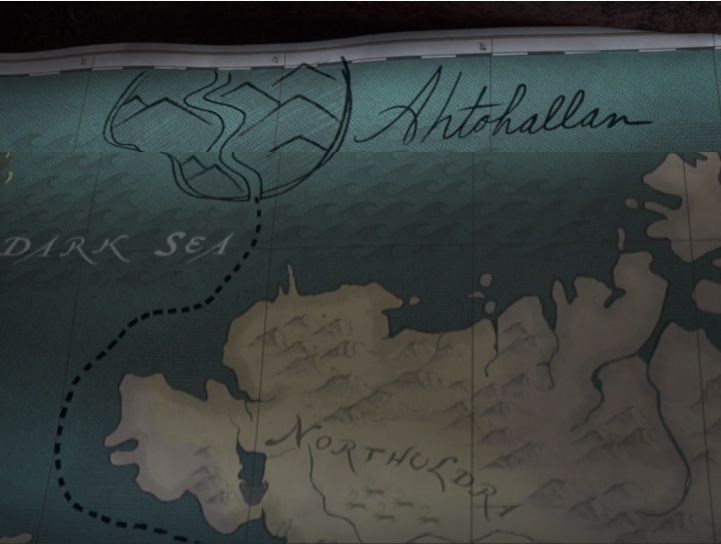
5. Ahtohallan
This is yet another controversial name for me. There is, as of yet (10 Mar 2021), no consensus about the etymology of the name. The information I will discuss here comes from this archived reddit thread.
The first theory: from Norwegian ættehallen ‘the ancestry hall’. Suggested by Buttstallion58.
The main problem with this theory is that it’s a Norwegian name, ostensibly used by a Finno-Ugric-speaking population. It’s possible that the filmmakers took a shortcut and used a Norwegian-based name, in which case…ouch.
The second theory: from Finnish Ahto ‘a water god’ and halla ‘frost’. Suggested by JoDawn67.
Finnish and Sámi, while both in the Finno-Ugric family of languages, are different enough that a Finnish speaker will not necessarily understand a Sámi speaker (and this varies depending on the version of Sámi, I guess). I am not even a beginner on Finnish mythology, so I can’t say if the god in question is shared between the groups, but the choice of Finnish over Sámi in this interpretation makes me uncomfy.
Still, ‘water god(‘s) frost’ is not a bad name.
The third theory: from Northern Sámi áhttán ‘ice in a fjord’ + hállan ‘slope’; or -hallan, the past participle of a frequentative marker -hallat for verbs. Suggested by Henkkles.
The above linguistic terminology oversimplified: -hallan is attached to verbs to denote that the action was done habitually in the past. But since the word it attaches to is a noun, the construction will make no sense. Henkkles finds no other words starting in aht- which would make sense in context, so by default, the name means:
áhttán ‘ice in a fjord’ + hállan ‘slope’ = Ahtohallan ‘ice in a fjord (on a) slope’
Or something like that.
There is no fjord in the Dark Sea though.
So the jury is out on this one! I apologise to all future readers of this post who speak any Sámi or Finnish – I don’t know these languages at all.
A short conclusion
The names in the Frozen series have been chosen apparently systematically in Frozen (2013), but then less so in Frozen II. I know the Frozen team went to Fennoscandia to learn about the Sámi culture, but the extent to which people have had to theorise about the place names in Frozen II leaves much to be desired.
It would not have been very difficult to come up with a more clearly Sámi-derived name for the people of the Sun (incidentally also an epithet for the Sámi). And while Ahtohallan is interesting as a name, the lack of an easy/sensible interpretation into Sámi is frustrating.
Of course, it could be that there is fervent discussion among the Sámi about this, which I just can’t read.
If you have a theory for any of the names, let me know in the comments! And subscribe~
 Queendom of the Crocus
Absolutely fascinating account of the etymology of the Frozen world’s various places! Ahtohallan and the Dark Sea’s conundrum sadly sound like they did take inspiration from “somewhere” in North European mythology, but that certainly didn’t overlap with any concern for linguistic accuracy.
Arendelle and the Isles as being closest to Norway and Denmark seem possible. I wonder if Finland or Sweden would fit in any way.
LikeLike
Hey AG,
Sweden is a possible candidate, being likewise split north-south into Swedish & Saami/Finnish cultural zones, but the maps of Arnadalr and the Norðaldra to its north show that to the west and north is a large water channel, leading me to believe that Arendelle’s geographical location is closer to Norway’s than to Sweden’s.
But it is definitely possible that Arendelle represents Sweden-Norway. I just don’t like that interpretation because in that case the main capital would be Stockholm, which is, again, not near a big ocean-way.
And for my Saga (and some other projects I can think of), an independent Norway/Arendelle is more interesting. Wouldn’t you agree? 😉
LikeLike