
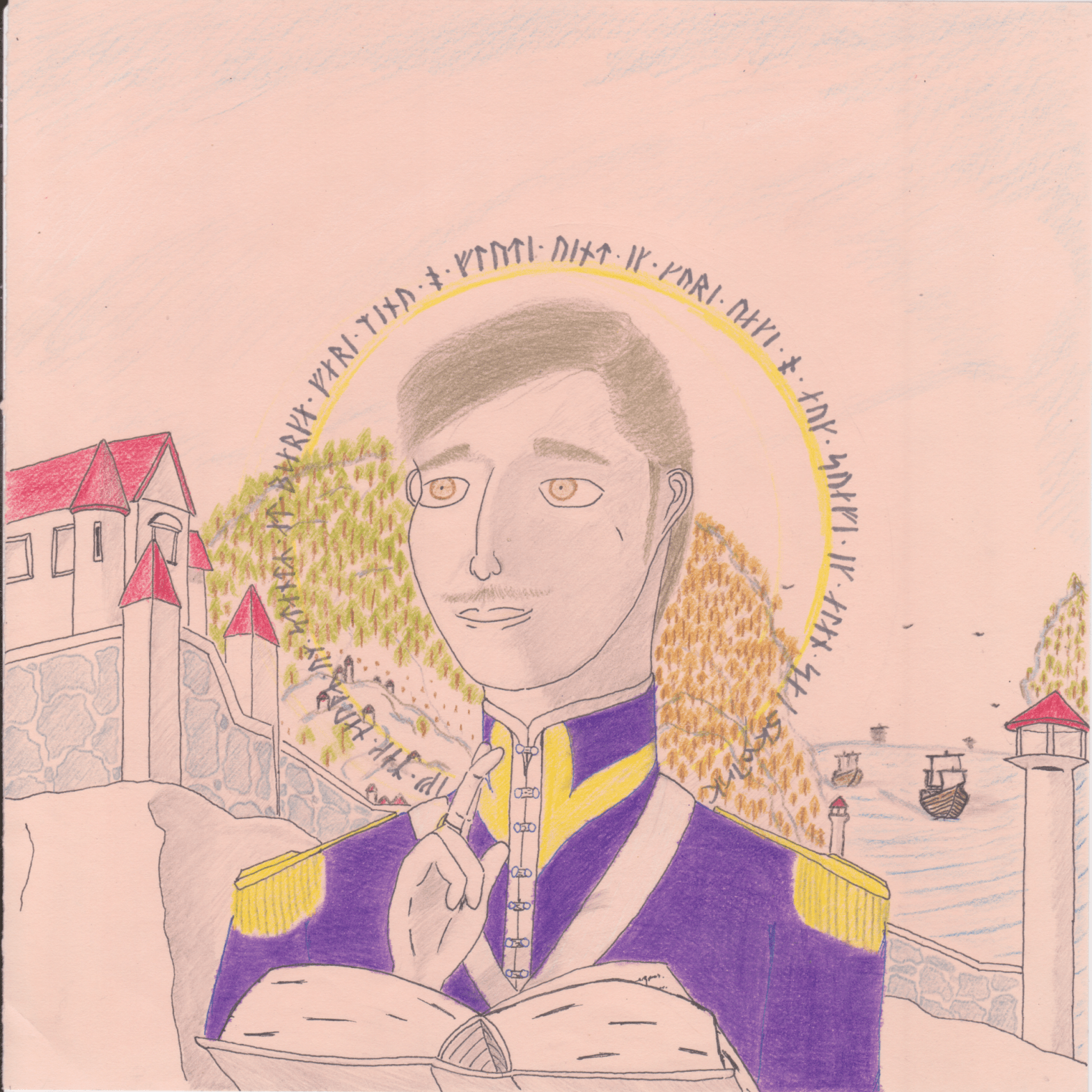
Click here to read the full text of the Agnarsqueth!
I recommend you to read the text first, and the explanation below later.
Finished the Agnarsqueth? Then scroll down ↓↓↓ for the nerd stuff~
Let’s go read a Chronicle!
What is a Chronicle?
Seriously, if you haven’t read the Chronicle, click this giant text to read it first.
This is the first entry in the Crocus Queendom Chronicles series. I am, in truth, not very good at writing long things. I often have small ideas and whip them up into small stories which give life to the fictional universes I come up with. I call these small stories chronicles, even if that is not the best word for them. Nevertheless, the word is stuck in my brain, so that’s what we’re calling them.
Agnarsqueth and Runes
The Agnarsqueth (my calque of Agnarskviða, ‘Agnar’s poem’) is a short tale detailing Agnar’s experience in the Northern Forest when the battle between the Norðaldra and the Arnadalingar broke out. We know he tripped and fainted, and we know he was rescued by Iðunn, and we know he was transported back to Arnadalr, but could he have experienced anything while he was unconscious?
Agnarr, as a character, doesn’t have much going for him. In Frozen he is just the enabler of Elsa’s destructive tendencies; in Frozen II he just tells a nice story that his wife later rounds up. Agnarr is like a narrator, necessary in the sense that he is needed to set the stage, but really not central to any part of the story. As with Kristoff, I want to give him more…life? in the Saga, Bk. II. And while thinking about him, something about him struck me.
Did you know that Agnarr seems to be able to read runes? Check out Panya’s blog, which I’ve linked to before, for a deciphering of the runes in Frozen. (Incidentally, that was the inspiration for my series on Queen Iðunn’s Letter: start with this link if you haven’t seen it.) But I just noticed that Agnarr is the one who finds the book, which means he knew what it meant.
Yeah, maybe he couldn’t read the runes, someone just told him, but come on, it would be so cool, right?
But how did it come to be that Agnarr learnt to read runes? How did anyone learn to read runes?
While the real history is probably that runes are a Germanic derivative of an old Italic alphabet, in Scandinavian mythology the runes are symbols of power, discovered by Odin when he sacrificed himself to himself. This is recorded in the Hávamál in a section commonly called the Rúnatal (Tale of the Runes), which you can find many translations for here. I have included some of it in the Agnarsqueth, and I am indebted to Prof. Haukurth for the translations, and if this mention does not suffice as a citation, please let me know.
Form of the chronicle
The main of the chronicle is written based on my understanding of ljóðaháttr (an Old Norse alliterative verse). Fun fact: Grand Pabbi’s dialogue is written this way in the Saga.
The end of the chronicle transitions back to my traditional metre, the same as in most of the Saga and In the Hall of the Mountain Queen. It’s supposed to be because the last part of the poem has relevance to the content of the Saga, but really, the whole thing is relevant to the Saga, so…
Well, I guess I just wanted to try ljóðaháttr. But also show a link to the grander narrative.
Extra things
After writing the main body of the chronicle, I realised that there is a myth about the Norse god Odin (in disguise as a person called Grímnir) and a boy named Agnarr. Odin has been imprisoned/tortured by Agnarr’s father, a king, but Agnarr comes to offer Odin a drink, not realising that he is caring for Odin. Odin eventually reveals his true form, subdues/kills Agnarr’s father, and makes Agnarr king.
Quite a coincidence here. According to Wikipedia, Grímnir can mean ‘hooded, masked one’, which is even more coincidental.
You will, of course, need to read the Agnarsqueth to understand the explanation above, so if you’ve made it this far without reading it, thank you and congratulations!
 Queendom of the Crocus