
Click here to read Part 2! | And click here to read Part 1!
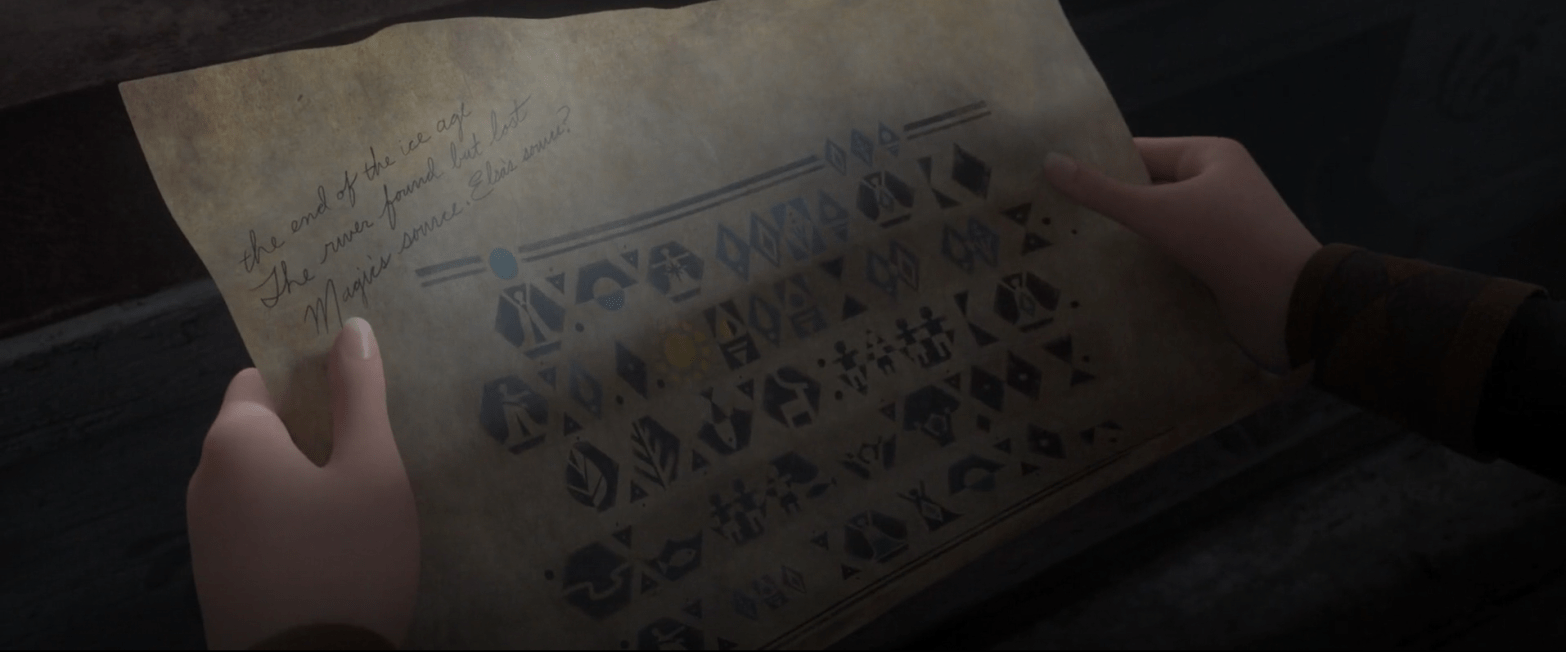
I highly recommend you to read Part 2 to see a description of the different signs in the thing. Part 1 is more just an introduction, but you might learn something along the way, who knows?
However, unlike in Part 2, I will be explaining my interpretations of the signs in a different order. I will tackle Lines 3 and 4 first, and then Lines 2 and 5, and then Lines 0 and 1.
Lines 3 and 4
Line 3

The leaves, fish, and reindeer at the start of this line are highly suggestive of the Norðalra civilisation. Even if the leaves here are not maple leaves, as seen in the Frozen II trailer, comparing the herding Norðaldra to the urbanised Arnadalr, I think this guess not a big stretch. The next two hexagons, with the person in shorts and the person in skirt, I guess refer to Agnarr and Iðunn. In the left-er hexagon, they are coloured oppositely: shorts (Agnarr) has a light upper background and dark lower background, and this is reversed for Iðunn. This suggests the conflict between their peoples – they met one another as enemies. The right-er hexagon then shows their union: their backgrounds become the same. But note: it is Iðunn’s background that changes. Her dark and light background switch places, leaving the right hexagon dark below and light on top.
As a side note, many hexagons in the whole letter are dark background below, light background on top. If we assume that ‘darkness’ in the script means ‘land’, or simply ‘not sky’, then the switch is a symbol of Iðunn moving south to Arnadalr after the sealing of the Northern Forest.
The last symbol in this line is Elsa, but before that there is this K looking symbol. It only appears one other time, in Line 1. I might guess that it means ‘thereby’, so, ‘from Agnarr and Iðunn, thereby will come a person of water (ice; i.e. Elsa)’, but I wouldn’t be confident about it.
Importantly, note that this line made this kind of sense when read left-to-right.
Line 4

I will skip the river and the fish signs first.
In the third sign in this line, ‘Agnarr’ and ‘Iðunn’ appear to be in the water – as you can see, there are little wave-like curves in the background they are in. (As you may remember, they die at sea about 15 minutes after Frozen starts.) The next glyph is ‘Iðunn’ and a fish, and look! the background has switched again, and Iðunn and the fish are in a top-dark, bottom-light hexagon, although still in the water. The next two glyphs show two figure separately drowning in the water. If I had to guess, the one on the left is Agnarr, and the one on the right is Iðunn, because of that background colour. The figure on the right has a background which is top-dark, bottom-light, and this only appears with the skirted figure.
In this context, the river might be the Arenfjord, the fjord which Arendelle sits on; and the fish thing might just represent the sea.
OR PERHAPS, the fish is a symbol for something?
Why does the fourth sign need to exist? In the third sign, Agnarr and Iðunn are already in the water. Why is there an extra symbol showing Iðunn, still in the water, with a fish? Is that fish communicating with her? And why must Iðunn be shown drowning separately from Agnarr? Did they die different deaths? Is that how Elsa is able to find Iðunn’s memory in Ahtohallan in Frozen II, but her father’s memory is nowhere to be found?
So many questions! All of which give interesting directions for the Saga, Book II!
And as a small summary, Lines 3 and 4 appear to be about Agnarr and Iðunn – how they met, what they will do, and how they will die.
And as a last detail, the two diamonds with a dot in them at the end of Line 4…yeah, I don’t understand that at all.
Lines 2 and 5
Line 2

Let’s start from the sun symbol in this line. The Norðaldra consider themselves the ‘People of the Sun’, so the sign could be referring to the Norðaldra in some way. Alternatively, it could literally being referring to the sun in the sky, which some of the Norðaldra grew up without ever seeing. The symbol for the Earth spirit(s) on the right of the sun, coloured in this strange, eclipse-looking way, makes me think that the literal sun explanation is probably more accurate – but I’ll have more to say about this later.
After this, there are the symbols of the Water spirit and the Earth spirit, and the ‘Earth’ symbol is coloured in the opposite way from the ‘Water’ symbol. There is a sign like a colon (this–> : ), and then the symbols of ‘Water’ and ‘Fire’ and then ‘Water’ and ‘Wind’ seem to overlap. This feels strange – it reminds me of the scenes when Elsa fought the Wind and Fire Spirits, only a few moments after she entered the Northern Forest. The signs overlap here – is this a sign of conflict, or of making peace? Elsa did both, actually!
And then at the end of the line, there’s an hourglass figure. I have no ideas.
But the strange thing about this line is that the events are described backwards. In the movie:
- Elsa pacifies the Wind spirit, and then the Fire spirit (signs on the right);
- Elsa is accepted by the Norðaldra, and then avoids the Earth spirit(s) (signs in the middle – is this the reason for different colouring for ‘Earth’ sign?);
- Elsa battles the Water spirit while trying to reach Ahtohallan. (first two signs?)
This suggests that this line should be read right-to-left, opposite from lines 3 and 4. Aside from a small apparent mistake in the sequence of events listed at point 2 above (Elsa is accepted by the People of the Sun before she avoids the Earth spirits), the rest checks out with my understanding of the movie’s events.
Line 5

Line 5 starts with, I guess, the same figure as Line 2. Then we have the signs for ‘Wind’, ‘Earth’, and ‘Fire’, and ‘Earth’ is still coloured differently. The next glyph contains a figure which does not appear anywhere else in the script. As I mentioned in Part 2, it looks like Elsa in her old ice dress. My guess is that this refers to her freezing in Ahtohallan. After all, the next sign shows the Elsa figure again, but with a light background while the person has turned dark – maybe meaning death? This might also explain why the Earth glyph is discoloured: when Elsa dies, the Earth spirits are still not pacified. Anna is the one who eventually makes them calm down.
The half-light and half-grey moon in the next glyph is interesting, and I’ll say more about it when I discuss Line 1 next. After that is that diamond with a dot again – still no idea – and then the downward-pointing thingy. I still have no clue what it means, other than a vague guess that it means ‘ending’, but there must be something more. This whole text doesn’t seem to mention Anna – is it a symbol meaning ‘it’s time to wait and see’? Was Anna not meant to be part of the prophecy?
Click here to skip to a discussion about Anna in this prophecy. But I would recommend reading this article to the end first.
For Line 5, reading it left-to-right seems to make more sense. Which is why it’s hard to see why Line 2 should be read right-to-left. Also, why are the parts about Agnarr and Iðunn stuffed in between two parts about Elsa? Yet Lines 2 and 5 still form a natural set, because the focus is now on Elsa and not her parents.
Lines 0 and 1
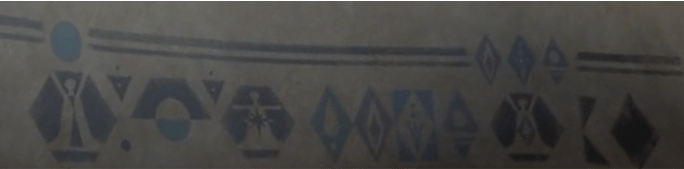
This line is probably the most annoying to interpret. But let’s start with that two-coloured circle, as I mentioned before.
I am inclined to say that the circle represents the sun over the Norðaldra sky, because the first glyph in Line 0 is a circle completely in grey (blue? I can’t tell), and then a person holding it up (or celebrating under it). It just…kinda makes sense I guess. This person is probably the same person depicted in Lines 2 and 5.
The third glyph is another person, in front of whom there is an eight-pointed star. As mentioned in Part 2, the star could be a reference to the fifth spirit’s compass sign, so maybe this is a representation of the fifth spirit (though I never thought the fifth spirit was a person…unless Iðunn/Elsa/Anna is the spirit…ugh…).
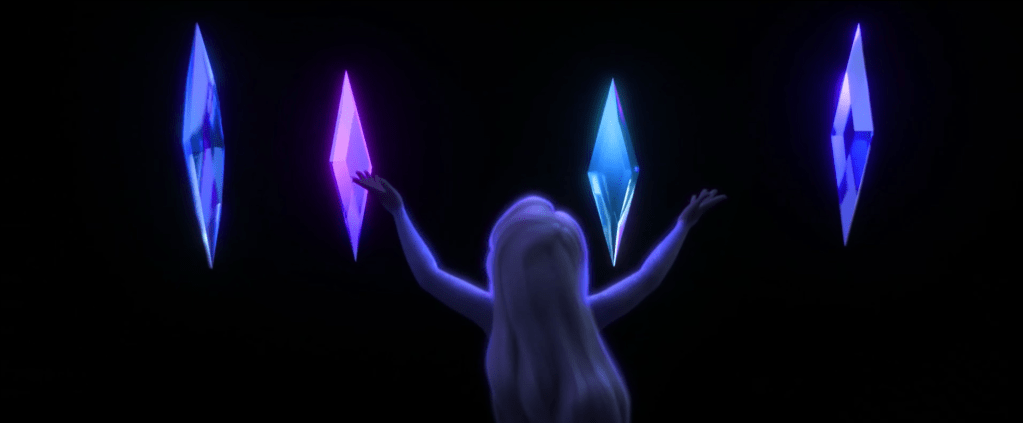
Then we have the four elemental spirits’ glyphs. Here, the Wind spirit’s glyph is coloured oppositely. Does this mean anything? Maybe it doesn’t, because in the promotional poster for Frozen II, the Wind spirit symbol is already coloured opposite to the rest. Maybe it does, because when the spirits were raging around the Northern Forest, only the Wind Spirit did something different and actually saved Iðunn and Agnarr. But this second explanation is weird because of the next glyph: Elsa! Because who else would control the four elemental diamonds? That scene in ‘Show Yourself’, when she makes the four diamonds rest in a compass pattern? It looks so much like this glyph!
And then at the end there’s another K, and a diamond with no dot this time. Does this mean ‘thereby something’ again, or something else?
This line is the vaguest of all the lines if you ask me. I have no good ideas about it, other than to say that it is a generic introduction to the bottom lines, which is at least a better-structed and more reasonable prophecy.
Of course, there are many ways you could choose to read this letter. Maybe each colon/hourglass shape is one phrase, and phrases can spill over across lines. This is just one interpretation – and that’s not to say I won’t try out a second one!
Anna and the Prophecy
As I mentioned, the prophecy doesn’t seem to mention Anna. It represents Elsa and her parents, the four elemental spirits, and then maybe the fifth spirit. But no Anna. Why?
Well, maybe, because Anna is the only one with a choice in the matter.
I have explained before that I interpret the fifth spirit as Knowledge. It knows many things because the memories of everyone are kept in the water, and it lives in a glacier; and it is very wise because it has all this knowledge at its disposal.
Assuming that Elsa’s ice powers were given to her by the Knowledge spirit, then Iðunn and Agnarr would be fated to visit Ahtohallan to find answers. Where else in the world would they have found answers for the origin of Elsa’s ice powers – and they had probably been searching, at the latest ever since Elsa and Anna’s little accident – a total of 10 years!
Elsa, also, would respond to the ‘siren call’ (I interpret it as the fifth spirit) and go north. She would be fated to find the truth about everything – and die in Ahtohallan. Why? Read on…
Anna, on the other hand, has always had a choice.
Instead of loving her sister, she could have grown to hate her for shutting her out. Even if that weren’t the case, Anna could always have chosen to stay behind to lead the people of Arnadalr while Elsa went ahead to find answers after the dale was cursed. Anna and the whole dale could have simply found somewhere else to live. The spirits wouldn’t punish the people, only the town’s memory, since the people in Elsa’s time had nothing to do with the invasion of the Norðaldra; but the town, built by the same invaders, had to go.
But once Elsa discovered the truth, she had to die. If she had been allowed to leave Ahtohallan, there was no guarantee that she would go back and destroy the dam. She could have walked away, determined to inherit her grandfather’s legacy. She could have chosen to be complicit in his invasion. (I’m not saying she would, but it is difficult for the descendants of someone to simply break from their inheritance.)
Instead, the spirit gave the choice to Anna. She could destroy the dam, and free her sister; or she could leave the dam be, and go on with her life. The fifth spirit would simply keep its chosen one on ice, and ensure that, if the Norðaldra were to disappear from the outside world, then so too would Arnadalr. But Elsa and Anna, being the inheritors of the invader (Runeard) and the invaded (Iðunn), couldn’t both die – they were both half-guilty and half-innocent. Therefore one half of the pair would be sacrificed – in this case Elsa, and the last one left to do her work in the world.
Interpreted this way, Anna is the only one not in the prophecy – but that is because she is the only one with a choice. As my mention in my preface to the Saga, Frozen II has an element of destiny and fate tied up in its story – but perhaps Anna was meant to be the exception. It would make an interesting theme to work with in Book II.
It also gives me a new appreciation for this line in ‘The Next Right Thing’:
But break it down to this next breath,
this next step,
this next choice,
is one that I can make!
Subscribe and share!
I’m not sure what content I’ll post next, but stay tuned!
 Queendom of the Crocus
good job! I enjoyed the whatever thingamawhatsit!!!
LikeLiked by 2 people